


Key Takeaways
- California’s new CCPA cybersecurity audit regulations require certain businesses to conduct annual cybersecurity audits and submit certifications to the California Privacy Protection Agency (CPPA) on a phased timeline beginning in 2028.
- These audits evaluate the effectiveness of an organization’s cybersecurity program, not just individual technical controls.
- Businesses should begin preparing well before their certification deadline by documenting security controls, assessing risk, and addressing gaps.
- Organizations with mature cybersecurity practices and well-maintained documentation will be in a much stronger position when audits become mandatory.
- Working with an experienced cybersecurity partner can simplify preparation while strengthening your overall security posture.
For many California businesses, the California Consumer Privacy Act (CCPA) has primarily been associated with consumer privacy rights such as data access, deletion, and opt-out requests. That is changing.
New regulations adopted by the California Privacy Protection Agency (CPPA) require certain businesses to conduct annual cybersecurity audits and submit certifications confirming those audits have been completed. Although the regulations became effective on January 1, 2026, the certification deadlines are phased in between 2028 and 2030 based on company revenue.
While those deadlines may seem distant, organizations that wait until the last minute could find themselves rushing to document security controls, remediate weaknesses, and demonstrate compliance. Preparing early allows businesses to improve security while avoiding unnecessary pressure as certification deadlines approach.

What Is a CCPA Cybersecurity Audit?
A CCPA cybersecurity audit is an independent evaluation of an organization’s cybersecurity program to determine whether it provides reasonable protection for the personal information the business collects, stores, processes, or shares.
It is important to understand what this audit is and isn’t.
A cybersecurity audit is not simply:
- A penetration test
- A vulnerability scan
- An IT health check
- A compliance questionnaire
Instead, it examines whether an organization’s overall cybersecurity program is appropriately designed, implemented, and maintained to address the risks associated with its data processing activities.
The regulations also require businesses to maintain documentation to support the audit and to submit an annual certification confirming completion.

Who Needs to Complete a CCPA Cybersecurity Audit?
Not every California business will be required to conduct these audits.
The regulations generally apply to businesses whose processing of personal information presents significant security risks, taking into account factors such as:
- Annual revenue
- The volume of personal information processed
- The sensitivity of the information collected
- The nature of the organization’s data processing activities
The specific applicability requirements are defined within the CPPA regulations and should be reviewed carefully when determining whether your organization falls within the scope of the audit requirement.
Even organizations that ultimately determine they are not required to complete a formal audit may find that preparing for one strengthens security, improves governance, and supports other compliance initiatives.
What Does the Audit Evaluate?
The audit looks beyond individual security controls to assess the maturity of an organization’s overall cybersecurity program.
Typical areas include:
- Security governance and policies
- Asset inventory
- Identity and access management
- Multi-factor authentication
- Network security
- Endpoint protection
- Encryption
- Logging and monitoring
- Vulnerability management
- Incident response planning
- Third-party and vendor risk management
- Employee cybersecurity awareness
- Data retention and secure disposal
- Business continuity and disaster recovery
Rather than asking whether a single control exists, auditors evaluate whether security measures work together to appropriately reduce risk across the organization.
Understanding the Certification Timeline
One of the biggest misconceptions is that businesses must complete audits immediately.
California established a phased implementation schedule based on annual revenue.
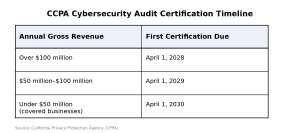
After the initial certification, covered businesses must continue completing annual cybersecurity audits and submit certifications each year.
Although several years remain before the earliest deadline, building a mature cybersecurity program takes time. Waiting until the year before certification could leave organizations scrambling to address issues that require months to resolve.
Why Preparing Early Matters
Organizations that begin preparing now often gain additional benefits, including:
- Better visibility into cybersecurity risks
- Stronger protection of sensitive information
- Improved executive oversight
- Better documentation of security practices
- Increased confidence from customers and business partners
Preparation also reduces the likelihood of discovering major security gaps shortly before an audit deadline.
While compliance cannot eliminate cyber risk, organizations with mature security programs are generally better positioned to prevent incidents and respond effectively when they occur.
How to Prepare for a CCPA Cybersecurity Audit
The strongest audit results typically come from organizations that treat cybersecurity as an ongoing business process.
A good place to start includes:
Inventory Sensitive Data
Understand what personal information your organization collects, where it is stored, who has access to it, and how long it is retained.
Review Existing Security Controls
Evaluate whether current security measures adequately protect sensitive information throughout its lifecycle.
Strengthen Identity Security
Review user permissions, implement multi-factor authentication where appropriate, and regularly remove unnecessary access.
Assess Third-Party Vendors
Many organizations rely on cloud providers, software vendors, and outside partners that process sensitive information. Vendor security should be part of any cybersecurity program.
Update Policies and Documentation
Well-written policies alone are not enough, but documenting procedures, security controls, and governance practices is essential for demonstrating compliance.
Conduct a Gap Assessment
An independent cybersecurity assessment before the required audit can identify weaknesses while there is still time to address them.

Common Mistakes Businesses to Avoid
Organizations preparing for future audits often encounter the same challenges.
Some of the most common include:
- Assuming existing security tools automatically satisfy audit requirements
- Waiting until the certification deadline approaches
- Overlooking third-party vendor risk
- Failing to document security processes
- Treating cybersecurity solely as an IT responsibility rather than an organization-wide governance issue
Avoiding these pitfalls now can make the eventual audit process significantly smoother.
Looking Beyond Compliance
The new CCPA cybersecurity audit requirements reflect a broader shift in cybersecurity expectations.
Regulators increasingly expect organizations not only to implement security controls but also to demonstrate that those controls are appropriate, documented, and regularly evaluated.
Businesses that begin preparing now will likely find themselves in a stronger position, not only for compliance but also for protecting customer information, supporting cyber insurance requirements, and building trust with clients and partners.
Compliance may be the catalyst, but a stronger cybersecurity program delivers benefits long after the audit is complete.
Frequently Asked Questions
Is a CCPA cybersecurity audit the same as a penetration test?
No. A penetration test evaluates specific technical vulnerabilities, while a CCPA cybersecurity audit reviews the effectiveness of an organization’s overall cybersecurity program, including governance, policies, risk management, and operational controls.
Can an internal IT team perform the required cybersecurity audit?
The regulations require that the audit be objective and performed by qualified professionals in accordance with recognized auditing standards. Depending on the organization’s structure, many businesses may choose to work with an independent third party to help satisfy these requirements.
Should businesses wait until their certification deadline to prepare?
No. Building documentation, strengthening security controls, and addressing identified gaps can take considerable time. Starting early allows organizations to spread the work over several years while improving security along the way.
Prepare for Tomorrow’s Compliance Requirements Today
The Swenson Group helps organizations evaluate their cybersecurity posture, identify risks, strengthen security controls, and safely adopt technologies like AI without exposing sensitive business data. Whether you’re preparing for future CCPA audit requirements or looking to improve your overall security strategy, our team can help you move forward with confidence. Reach out to our team today and schedule a Strategic Technology Review and take the next step toward stronger security and long-term compliance.
About TSG
The Swenson Group (TSG) is an award-winning Bay Area Managed Service Provider that has helped thousands of organizations achieve more by leveraging cost-effective technologies to become more productive and secure. Services include Managed Print, Document Management, IT Services and VoIP. Products include MFPs, Copiers, Printers, Production Systems, Software and Solution Apps. For the latest industry trends and technology insights, visit TSG’s main Blog page.