
No single AI model is best for every business task. GPT, Claude, Gemini, and other leading models offer different strengths in writing, research, data analysis, and automation. A centralized AI platform gives businesses access to multiple models in one secure environment, helping teams choose the right AI for each task while maintaining control over data security, costs, and AI governance.
Ask ten people in your office which AI tool they use, and you may get ten different answers. One swears by ChatGPT for drafting emails. Another relies on Claude to summarize contracts. Someone in marketing is experimenting with Gemini, and your newest hire mentioned DeepSeek because it’s free.
There’s no doubt that having a variety of AI tools gives your team more options. The challenge comes when people choose their own tools, create personal accounts, and paste company information into them without anyone else knowing.
Here in the Bay Area, that’s already the norm. A Microsoft and LinkedIn study of Bay Area knowledge workers found that 57% of local AI users bring their own AI tools to work. At The Swenson Group, we see the same pattern in the businesses we support every week. In this post, we compare leading AI platforms by use case, then explain why giving your team access through one secure, centralized AI platform is a simpler way to get the benefits of AI while managing the risks.
Key Takeaways
- No single AI model is best at everything. GPT, Claude, Gemini, Grok, Llama, DeepSeek, Mistral, Kimi, GLM, and Cohere Command each excel at different tasks.
- Matching the model to the task improves output quality, speed, and cost.
- Tool sprawl creates shadow AI, which IBM links to one in five data breaches and $670,000 in added breach costs.
- California’s updated CCPA regulations raise the bar for how businesses document their use of automated technology and personal data.
- One centralized AI platform gives employees the right model for every job while giving leadership visibility, governance, security, and predictable costs.
Why No Single AI Model Does It All
The AI market moves fast. New versions arrive regularly, and a model that leads in one area may fall behind in another. One may be a better fit for coding, another for research, while others offer faster responses or lower costs. The best choice depends on the job you want it to do.
For a business, that means the question isn’t “Which AI should we standardize on?” It’s “How do we give our people the right AI for each task, safely?”

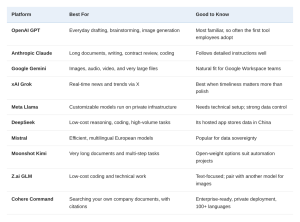
Comparing the Leading AI Platforms by Use Case
Here’s how we see today’s major platforms, based on where each one tends to shine in day-to-day business work.
These comparisons give you a starting point. To find the right fit, try the models on work your team handles regularly, such as reviewing contracts, drafting campaign materials, or summarizing support tickets. Compare the results for accuracy, clarity, and how much editing they require.
 The Hidden Cost of Ten Tools and Zero Visibility
When AI adoption happens one personal account at a time, leadership loses sight of where company data is going.
This is called shadow AI, and it’s widespread. A 2026 BlackFog survey found that 49% of employees use AI tools their employer hasn’t approved, and 51% have connected AI tools to other work systems without IT’s knowledge.
The financial impact is real. According to IBM’s Cost of a Data Breach Report, one in five organizations suffered a breach tied to shadow AI, and companies with high levels of shadow AI paid an average of $670,000 more per breach. Only 37% of organizations had policies to manage AI or detect shadow AI. Meanwhile, the average cost of a U.S. data breach hit a record $10.22 million.
For California businesses, there’s a compliance risk too. Updated CCPA regulations took effect January 1, 2026, adding requirements around automated decision-making technology, risk assessments, and cybersecurity audits. It’s hard to document how your business uses AI when you don’t know which tools your employees are using.
Then there’s the cost of sprawl: overlapping subscriptions, expensed accounts nobody tracks, and no way to tell which tools are delivering value.
Why One Platform Can Simplify It All
The answer is to bring every model your team needs under one roof, where IT and leadership can see and manage it. Here’s what that looks like in practice.
Centralized Access: The Right Model, One Login
With a centralized AI platform, employees sign in once and choose the model that fits the job. Your writer uses Claude for a long proposal, your analyst uses Gemini to work through a large spreadsheet, and your support lead uses a low-cost model to summarize tickets. No one has to juggle multiple accounts, and no one has to guess which tool is approved.
Governance You Can Enforce
Centralization gives you a single place to set the rules. You decide which models are available, which teams can use them, and what types of data are off-limits. Usage is logged, so you have a clear record of how AI is being used across the business. That record is what auditors and regulators increasingly expect to see.

Security That Travels With Your Data
Instead of company information flowing into dozens of consumer apps, it moves through one managed environment with business-grade protections. Sensitive data can be filtered or masked before it reaches a model, access is tied to your existing user accounts, and when an employee leaves, their AI access goes with them.
Faster, Broader User Adoption
Shadow AI usually happens because approved tools feel limited or hard to use. When employees can access the best models in one place, they have no reason to go around IT. Shared prompts, templates, and workflows also help less experienced users get value quickly, so AI benefits the whole team, not just a few power users.
Predictable, Controlled Costs
One platform replaces a patchwork of individual subscriptions with a single, manageable investment. You can see which models and teams drive value, route routine tasks to lower-cost models, and budget with confidence.
What This Looks Like for a Bay Area Business
In a 2026 KPMG survey of San Francisco business leaders, 91% said AI will be a top investment priority this year, and 70% plan to increase AI investment specifically to reduce business risk.
Picture a 50-person professional services firm in the Tri-Valley. The partners use one AI tool, the admin team uses another, and a few employees pay for their own subscriptions. Client files are uploaded to unvetted tools, and when a client asks how the firm protects their data, nobody has a confident answer.
Now picture that same firm with one centralized AI platform. Every employee has access to the right models for their work. Client data stays within approved guardrails. Leadership can see adoption and spending in one dashboard, and the firm can answer client and compliance questions with documentation instead of guesswork. The team gets more out of AI, and the business takes on less risk.
How The Swenson Group Helps
For more than 30 years, The Swenson Group has helped Bay Area businesses adopt new technology without adding risk or complexity. Today, that includes helping organizations put AI to work safely through a centralized platform that gives employees access to leading AI models with the governance, security, and visibility leadership needs.
Our approach follows the same proven process we use for every engagement:
- Assess. We identify how your team is using AI today, including tools IT may not know about, and where AI can deliver the most value.
- Implement. We deploy a centralized AI platform with the right models, access controls, and data policies for your business, and help your team get up to speed.
- Monitor, support, and grow. Our team keeps your AI environment secure, tracks usage and value, and adjusts as new models and regulations emerge.
Because AI touches everything from your network to your documents, it shouldn’t be managed in isolation. We support it alongside your Managed IT, cybersecurity, and workflow automation, so everything works together.
Ready to give your team the right AI for every task, without the risk? Schedule a free discovery meeting with The Swenson Group, or take our 3-minute tech self-assessment to see where your business stands.
Frequently Asked Questions
Which AI model is best for business?
There isn’t one best model for every task. GPT is a strong all-rounder, Claude excels with long documents and writing, Gemini handles images, video, and large files well, and Cohere Command is built for searching company knowledge. A centralized AI platform lets your team use the right model for each job without managing separate accounts.
What is shadow AI, and why is it a risk?
Shadow AI is the use of AI tools that a company hasn’t approved or doesn’t know about, often through personal accounts. It puts sensitive data outside IT’s control and makes compliance harder to prove. IBM found that organizations with high levels of shadow AI paid an average of $670,000 more per data breach.
How does a centralized AI platform help with California compliance?
A centralized platform gives you one place to control which AI models employees use, what data they can share, and how usage is logged. That visibility makes it far easier to document AI use and support the risk assessments and cybersecurity audits required under California’s updated CCPA regulations. As always, work with legal counsel to confirm your specific obligations.
About TSG
The Swenson Group (TSG) is an award-winning Bay Area Managed Service Provider that has helped thousands of organizations achieve more by leveraging cost-effective technologies to become more productive and secure. Services include Managed Print, Document Management, IT Services, Managed AI and VoIP. Products include MFPs, Copiers, Printers, Production Systems, Software and Solution Apps. For the latest industry trends and technology insights, visit TSG’s main Blog page.