


Measuring AI’s value starts with comparing the full cost of using it against changes in completed work. Track time spent, review and correction requirements, quality, and business outcomes. Then determine whether those improvements justify the investment.
Key Takeaways
- Measure the time it takes to finish and approve work, including checking AI’s output.
- Time saved creates capacity. Financial savings depend on what your business does with that capacity.
- Include training, support, and review time alongside subscription costs.
- Use the results to decide where to expand AI, adjust, or stop spending.
Your team has access to AI. People are using it, and some say they couldn’t imagine going back.
That sounds encouraging. Then a renewal comes up, or someone asks whether the company should purchase more licenses.
But what has improved? Are customers getting answers sooner? Is your team completing more work? Are people spending less time on a task, or spending that time correcting what AI produced?
At The Swenson Group, we believe technology investments should earn their place in your business. For the Bay Area organizations we serve, measuring AI’s value means looking beyond enthusiasm and asking what has changed since people started using it.
Here are seven questions to help you assess whether your AI investment is delivering value, without turning the process into another lengthy assignment for your team.
1. What Result Were You Expecting?
“Help people save time” is a reasonable starting point, but it’s difficult to evaluate without getting more specific.
Perhaps your sales team hoped to shorten the time between a customer conversation and a completed proposal. Your service team wanted to answer more questions without customers calling back. Your managers wanted reports ready earlier, with fewer corrections.
Each calls for a different measure.
For proposals, you might compare the time from receiving complete requirements to sending the approved document. For customer service, you might track resolved requests alongside repeat contacts.
Write down the intended result in one sentence:
“We’re using AI to reduce proposal preparation time while maintaining our standards for accuracy and customization.”
That gives everyone something concrete to evaluate. At TSG, we believe a technology investment should start with a clear answer to “What will this help our business do better?” The same question belongs in your AI review. If the original objective was unclear, establish one before expanding the investment.

2. What Can Bay Area Research Teach Us About AI Results?
Research with a local connection reminds us that AI’s benefits can vary considerably.
In Generative AI at Work, coauthored by Stanford’s Erik Brynjolfsson, researchers studied an AI assistant used by 5,172 customer support agents. Access to the assistant increased the number of issues resolved per hour by 15% on average. Less experienced workers saw improvements in speed and quality, while the most experienced workers saw smaller speed gains and some declines in quality.
Your newest team member and your most experienced specialist may get very different value from the same tool.
When reviewing your own results, separate them by role, experience, and task where possible. A companywide average might lead you to expand something that helps only one group or cancel something that delivers substantial value for another.
3. Are You Measuring the Whole Task?
An AI tool can produce an answer in seconds. That doesn’t tell you how long it takes to produce something your business can use.
Include the time spent:
- Gathering and preparing information.
- Explaining the request to the tool.
- Checking facts, calculations, and completeness.
- Making corrections and obtaining approval.
Compare that total with the previous approach.
Suppose a report previously took an hour to prepare and review. AI produces a draft in five minutes, but checking and revising it takes another 40. The improvement is 15 minutes.
That may still be worthwhile, especially for a recurring report. It gives you a more credible basis for a decision than counting only the drafting time.
Use several comparable examples. One unusually simple request can make results look better than they are, while one complicated case can make a helpful tool look disappointing. Keep the person’s experience and the difficulty of the work in mind, too.
4. Does Time Saved Translate Into Business Value?
This is where AI return calculations can become misleading.
Ten hours saved doesn’t automatically mean ten hours of payroll disappears. Your people are still working, and your business is still paying them.
The value depends on what happens next.
Does the team use that time to clear a backlog? Can you accept additional work without adding overtime? Are account managers spending more time with customers? Can the business grow before another hire becomes necessary?
“If AI gives your team ten hours back each month, ask what those ten hours make possible,” says Dean Swenson, President of The Swenson Group. “Maybe you can take on another customer, get proposals out sooner, or give your people breathing room during a busy week. That’s where the value becomes meaningful to the business.”
A Gartner case study offers an example of AI delivering measurable business results. U.S.-based Solo Brands introduced a generative AI customer service chatbot that increased its automated resolution rate from 40% to 75%. Gartner also reported improvements in customer satisfaction and sales, along with fewer escalations to human representatives.
For businesses evaluating AI, those are the kinds of results worth tracking. The value isn’t simply that AI answers questions faster. It’s whether customers receive the help they need and employees have more time for work requiring their attention.
Consider this hypothetical example, using assumed figures:
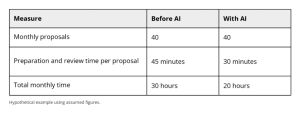
The team gains ten hours of capacity each month. At an assumed labor cost of $60 an hour, that represents $600 in staff time.
If the ongoing AI costs allocated to that work total $300 monthly, the estimated capacity value exceeds those costs by $300. That is not automatically $300 in cash savings.
To make the financial case, identify whether the additional capacity reduces paid overtime, avoids outside costs, or supports additional profitable work. Keep those outcomes separate from the value of time made available.
5. What Does AI Cost Beyond the Subscription?
The license price is only part of the calculation.
Your initial investment may include configuration, training, and connecting the tool with existing systems. Ongoing costs may include support, administration, usage charges, and maintaining the information AI relies on.
There is also the time your people spend learning how to use it.
Separate initial costs from recurring costs so you can see both the investment required to get started and the expense of continuing.
For example, a successful first month might not recover the cost of initial training. That doesn’t make the investment unsuccessful. It means you should assess how long the expected benefits will take to cover the initial spending.
Use the same period when comparing costs and benefits and avoid counting review time twice if it is already included in your task measurements.
At TSG, we encourage looking at the full cost of a technology decision. A low subscription price means little if using the tool creates substantial additional work.
6. Is Quality Improving Alongside Speed?
Faster completion has limited value if the result creates problems for someone else.
A proposal may reach the customer sooner but contain incorrect pricing. A response may answer the first question while prompting two follow-up calls. A report may look polished but omit information a manager relies on.
Choose a quality measure alongside your time measure.
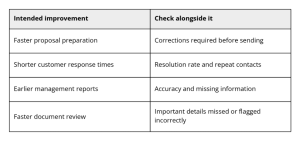
Keep the review manageable. A regular sample of completed work can reveal patterns without requiring someone to inspect every task solely for measurement.
Ask the people receiving the work for feedback, too. A department may report saving time while another department takes on extra checking. Your assessment should capture that transfer.
Customer feedback and staff experience also matter, even when they don’t translate neatly into a dollar figure. Record them alongside the financial measures without assigning an invented value.
7. What Should You Do With the Results?
Set a review date and give someone responsibility for bringing the findings together. For frequently repeated work, a 30- or 60-day review can provide an initial picture. Less frequent tasks may require longer.
Compare similar periods and note other changes, such as staffing, demand, or new software. Those can affect the results independently of AI.
Then choose a direction:
Expand it when the improvement is repeatable, quality holds up, and the costs make sense. Confirm that the next team has similar requirements before assuming it will achieve the same results.
Adjust it when the potential is clear, but something is limiting the benefit. Your team may need better instructions, more relevant information, or a narrower task.
Stop or pause it when the tool adds more work than it removes, fails quality checks, or costs more than the benefit justifies.
People should be comfortable reporting disappointing results. If they expect an AI trial to succeed, you may hear about impressive output and miss the corrections behind it.
What to Do Next
At The Swenson Group, we believe our role as your technology partner includes helping you assess whether an investment continues to make sense. That means reviewing the cost, listening to the people using the tools, and connecting the results to your business goals.
Based in Livermore and serving organizations across the Bay Area, TSG brings that perspective to our Managed AI Services. Whether you’re considering more licenses or questioning the value of tools you already have, talk with our team about where to focus next.
Frequently Asked Questions
What if we didn’t measure the task before introducing AI?
Use reliable historical records where available, or compare similar tasks completed with and without AI under appropriate conditions. Treat staff estimates as a starting point and verify them before making larger spending decisions.
Should we calculate AI’s value for each person?
Start with the task or team. Individual results can help identify training needs, but differences in workload and experience can make direct comparisons misleading.
Can AI be worth keeping if it doesn’t save time?
Yes. It may improve completeness, consistency, accessibility, or the quality of a decision. Define that benefit and gather evidence that it occurs. Then decide whether it justifies the cost.
About TSG
The Swenson Group (TSG) is an award-winning Bay Area Managed Service Provider that has helped thousands of organizations achieve more by leveraging cost-effective technologies to become more productive and secure. Services include Managed Print, Document Management, IT Services, Managed AI and VoIP. Products include MFPs, Copiers, Printers, Production Systems, Software and Solution Apps. For the latest industry trends and technology insights, visit TSG’s main Blog page.