

If you’ve shopped for a Managed IT, Cybersecurity, or Managed Print provider recently, you’ve probably noticed the landscape looks different than it did five years ago. Familiar local companies now operate under new corporate brands. Longtime account managers disappear. Pricing changes after a transition period. These aren’t isolated events. They’re part of a broader shift in how technology providers are owned and operated.
For many businesses, evaluating a provider starts with comparing services, pricing, certifications, or response times. Those factors matter, but there’s another consideration that’s often overlooked: ownership. Who owns your technology provider can influence how decisions are made, how long leadership remains in place, how flexible the company can be, and what priorities shape your experience over time.
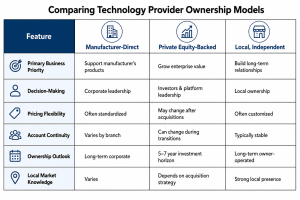
Today, most technology providers fall into one of three ownership models: manufacturer-direct, private equity-backed, or independent and locally owned. Understanding the differences can help you choose a partner whose business priorities align with your own.
 Key Takeaways
- Technology providers generally fall into three ownership categories: manufacturer-direct, private equity-backed, and independent, locally owned.
- Each model operates with different business priorities, whether that’s supporting a manufacturer’s product portfolio, expanding enterprise value for investors, or building long-term client relationships.
- Private equity has become a major force in the managed services industry. According to the 2026 MSP M&A Report, 466 managed services acquisitions closed across North America in 2025, a 20% increase over the previous year.
- Ownership can influence service continuity, decision-making, pricing flexibility, and the long-term direction of your technology partnership.
- Asking a few questions about ownership before signing a contract can help you avoid surprises later.
Why Ownership Has Become More Important
Industry consolidation is accelerating
The technology services industry has changed rapidly over the past several years. Thousands of independent providers still operate across North America, but consolidation has accelerated as manufacturers expand their service organizations and private equity firms acquire regional providers.
According to the 2026 MSP M&A Report, the managed services market remains highly fragmented, with roughly 40,000 providers across North America. Even the largest 100 firms account for less than 15% of the market, creating significant opportunities for acquisitions and consolidation.
Industry Snapshot
- Approximately 40,000 Managed Service providers operate across North America.
- The 100 largest providers control less than 15% of the market.
- 466 MSP acquisitions closed in 2025, representing a 20% increase over 2024.
Why this matters for customers
For customers, this means the company you’re evaluating today may not look the same several years from now. Ownership changes can influence leadership, staffing, pricing strategies, service models, and long-term planning. Understanding who owns your provider and what motivates that ownership gives you valuable context beyond what’s included in a proposal.
 Understanding the Three Ownership Models
1. Manufacturer-Direct Providers
Manufacturer-direct providers are sales and service organizations owned by the companies that produce the equipment or software they sell. Examples include direct branches of major copier, printer, or technology manufacturers.
Advantages
Working directly with a manufacturer can offer several benefits:
- Early access to new products and technologies
- Specialized product expertise
- Direct access to manufacturer resources and support
- Strong alignment for organizations standardized on a single technology platform
Potential considerations
Manufacturer-direct organizations naturally focus on their own product ecosystem. Recommendations often center around that manufacturer’s portfolio, and pricing, service policies, and escalation processes are typically standardized across multiple regions.
For businesses that rely on multiple technology vendors or require highly customized support, those standardized processes may offer less flexibility than an independent provider.
2. Private Equity-Backed Providers
Private equity-backed providers represent one of the fastest-growing segments of the technology services industry.
Growth through acquisition
According to the 2026 MSP M&A Report, 466 managed services acquisitions closed across North America during 2025, representing a 20% increase over the previous year and more than $4.3 billion in disclosed transaction value.
Investment firms continue acquiring MSPs because the industry remains highly fragmented. By combining regional providers, they can build larger organizations with broader geographic coverage and expanded service offerings.
Benefits of larger organizations
Private equity investment often brings additional resources that many businesses value, including:
- Expanded cybersecurity expertise
- Larger engineering teams
- Greater investment in automation and service platforms
- Broader geographic coverage
- Increased purchasing power and vendor relationships
Organizations with multiple offices or complex infrastructure may find these expanded capabilities particularly valuable.
What customers should know
Like every ownership model, private equity-backed providers operate with specific business priorities. Investment firms typically acquire companies with the goal of increasing enterprise value before eventually selling the business. The 2026 MSP M&A Report notes that many investment firms work within approximately five-to-seven-year ownership cycles.
Ownership transitions can sometimes lead to changes in leadership, account management, internal processes, or pricing strategies as acquired companies are integrated into a larger organization.
Research published by AXA XL, also found that 68% of private equity clients experienced an increase in cybersecurity incidents during the month an acquisition closed, as attackers attempted to exploit organizational disruption and staffing changes.
Questions Worth Asking
- Has your company been acquired in the past three years?
- If ownership changes again, what happens to my contract?
- Will my account manager and service team stay the same?
A balanced perspective
Private equity ownership does not automatically result in poor service. Many PE-backed providers deliver exceptional technical expertise, invest heavily in cybersecurity, and support clients across multiple locations.
The important consideration is understanding how ownership priorities align with your organization’s expectations for stability, flexibility, and long-term partnership.
3. Local, Independently Owned Partners
Independent providers are privately owned businesses operated by local ownership rather than a manufacturer or investment group.
Local ownership and decision-making
Independent providers vary considerably in size, expertise, and service offerings. What often distinguishes them is where decisions are made.
Staffing, pricing, investments, and customer service policies are typically determined by local leadership rather than a national corporate office or outside investors.
Building long-term relationships
Because independent providers aren’t generally working toward an acquisition or supporting a parent company’s product strategy, long-term customer relationships often become a primary measure of success.
For organizations that value continuity, local accountability, and direct access to decision-makers, this ownership model may offer meaningful advantages beyond the technology itself.
This is the model The Swenson Group has followed for more than 30 years. As a privately owned Bay Area technology partner, we’ve remained focused on helping local businesses build long-term technology strategies.
Questions to Ask Any Technology Provider
Before signing a new agreement or renewing an existing one, consider asking these questions:
- Who owns your company, and has ownership changed within the past three years?
- If the company is acquired, what happens to my contract, pricing, and account team?
- Who makes decisions about my account? Local leadership or a corporate office?
- How long has my likely account manager or service team been with the company?
- Can you provide references from clients who have worked with you for ten years or more?
A provider that answers these questions openly demonstrates transparency. If the answers are vague or difficult to obtain, it’s worth asking why.
The Bottom Line
Choose the ownership model that matches your priorities
Manufacturer-direct organizations, private equity-backed providers, and independent companies all serve businesses successfully every day. The best choice depends on your priorities, your technology environment, and the kind of relationship you want from your provider.
Technology decisions often focus on products, pricing, and service levels. Those are all important. But the company behind those promises deserves just as much attention. Ownership influences how decisions are made, how organizations adapt to change, how consistently service teams remain in place, and what happens when your needs don’t fit a standard playbook.

Before making your next technology decision, spend a few minutes learning who owns the provider you’re considering and how that ownership influences the way they do business. The answers may tell you as much about your future experience as the proposal itself.
At The Swenson Group, we’ve remained privately owned for more than 30 years because we believe lasting partnerships are built through consistency, accountability, and local decision-making. We’re focused on helping our clients build technology strategies that support their businesses for years to come.
To learn more about the difference working with a locally owned technology partner can make, contact The Swenson Group today.
Frequently Asked Questions
How can I tell if my technology provider has been acquired?
Search the company’s name along with terms like “acquisition,” “merger,” or “acquired.” Most transactions receive press coverage or are announced on the provider’s website. You can also ask your provider directly who owns the company today. A transparent answer is often a good indicator of how the organization communicates with its customers.
Does working with a locally owned provider usually cost more?
Not necessarily. National providers and large organizations often have broader corporate overhead, while independent providers may have greater flexibility to tailor pricing around individual client needs. Compare the overall value of the relationship, including responsiveness, expertise, service quality, and long-term support, rather than focusing solely on monthly pricing.
What happens if my provider is acquired while I’m under contract?
Most service agreements include provisions explaining how contracts transfer during a merger or acquisition. In many cases, the agreement automatically moves to the new owner. Reviewing assignment and termination clauses before signing a contract can help you understand your options if ownership changes in the future.
About TSG
The Swenson Group (TSG) is an award-winning Bay Area Managed Service Provider that has helped thousands of organizations achieve more by leveraging cost-effective technologies to become more productive and secure. Services include Managed Print, Document Management, IT Services and VoIP. Products include MFPs, Copiers, Printers, Production Systems, Software and Solution Apps. For the latest industry trends and technology insights, visit TSG’s main Blog page.